

Shooting stars and dark skies at the windmill
Our municipality, Mação, is part of the Aldeias do Xisto network, certified as one of Portugal's Dark Sky Starlight Tourist Destinations - and you won't find the sky much darker than it gets here at the windmill! Our nearest neighour is a tiny village a few kilometres away and the light polution here is minimal, so it's a magical place to stargaze. You can see shooting stars here all year round, but the Perseid meteor showers in August are one of the best times, and if you stay up late enough you will not be disappointed. We advise taking a few blankets, some snacks and a hot drink outside and watching in comfort, or - like our last guests - set your alarm clock mega early and get up before dawn to see the best show.
Us humans have observed the perseid showers for thousands of years and I thought it would be interesting to read up on a few of the ways they have been interpreted.

The tears of Saint Lawrence/As lágrimas de São Lourenço
The appearance of the meteor shower coincides with the catholic feast of St Lawrence on August 10th. For this reason, folklore in Portugal, Spain and Italy has associated the shooting stars with the falling tears or sparks from the saint's martyrdom (St Lawrence was burned to death for refusing to give the church's wealth to the Roman authorities and instead gave them to the poor).
Gods glimpsing at us
The ancient Greek astronomer Ptolemy believed that a shooting star was the moment when the heavens opened and the gods looked down. If this theory holds, it would also be a good time to ask the Gods for something. It's possible that Ptolemy was the origin of wishing upon a star.
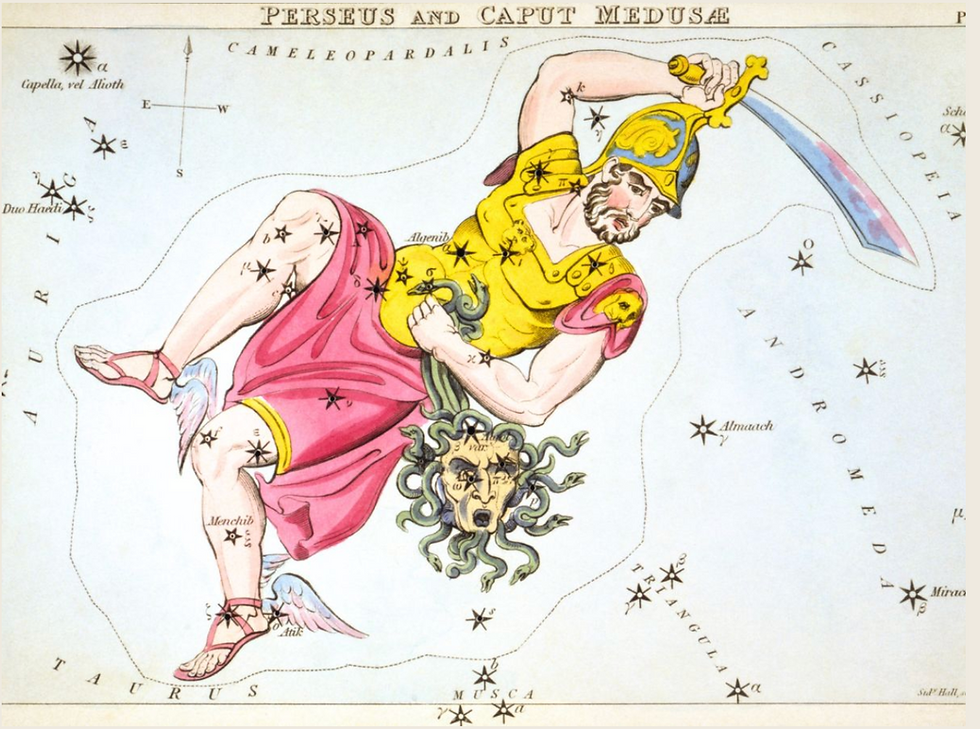
The shower is called the Perseids because the meteors appear to come from the Perseus constellation, named after the Greek hero who killed Medusa and rescued Andromeda from a sea monster. Much of the story of Perseus is scattered across the night sky and it's fun to spot all the characters up there (Andromeda, the princess he rescued; Cetus, the sea monster he saved her from; and even her parents, Cassiopeia and Cepheus).
The dust from a comet
Here's the less romantic side of shooting stars - turn away now if you want to remain ignorant and romantic! Meteors come from leftover comet particles and bits from broken asteroids. According to the NASA webpage, every August Earth passes through debris left behind by Comet 109P/Swift-Tuttle (discovered in 1862 by a guy called Swift, and a guy called... you guessed it!). The particles are often tiny, but they hit our atmosphere at about 59 km per second and there they disintegrate to become fiery streaks in the sky.
The Perseids Meteor Shower, which peaks in mid-August, is considered the best meteor shower of the year. At their most bountiful stages you can see 50 to 100 meteors per hour.
What they mean to us?
Well, here at the windmill we have all kinds of guests who come to appreciate the remote location and many of them see shooting stars. Whether those guests see them as comet debris, tears of a saint, or chances to interact with the gods, there is one thing they all have in common. The night sky gives us a chance to stop and look at something natural and real and take a moment of wonder.


Comments